UNI-SQUARE
Improving Employment of New Graduates, Contributing to Long-term Growth

In the July, August, and September issues of UNI-SIGHT, UNI-SQUARE introduces the winners of UNIVA AWARDS 2021. In this, the July issue, the featured winner is UNIVA Paycast (UPC)’s Karen Yajima. Yajima joined UPC as a new graduate in 2018. She was assigned to the Management Division, with responsibilities in both HR and general administration. In 2019, she was put in charge of hiring new graduates. She saw concerns she had felt when joining the company as a new graduate as an opportunity and made her goal the establishment of a new new-graduate hiring system. Here we introduce how this young employee not only succeeded in better understanding the feelings of students seeking jobs but also established a system that contributes to the company’s growth.
From Concerns Felt Five Years Earlier to Concrete Measures

Since 2018, when UPC hired new graduates for the first time in three years, UPC has hired from two to four new graduates every year. On April 1, 2022, four new graduates were inducted into the company. They had been chosen from UPC’s largest ever pool of applicants, forty-four. This was the best possible evidence of the company’s appeal to students. Yajima became a UNIVA AWARDS 2021 winner not only because she greatly improved UPC’s new graduate hiring system. Her work was seen as a major contribution to the company’s future growth. The improvements were based on her personal experience as a new graduate hire five years earlier.
“When I was job hunting in 2017, UPC was hiring new graduates for only the second time, and the first time in three years. I was busy looking for a job in mass media or advertising. That is why I was interested in UPC, whose business was related to advertising. I applied and was unofficially accepted. However, while applying and receiving an informal offer, even after formally joining the company, there were many things that made me feel uneasy about the way it was organized.”
Back then, notifications whether or not there would be an interview and the date and time of the next interview were slow to arrive. That made it difficult to schedule job-hunting activities at other companies. After I joined the company, it was off-putting that training content wasn’t decided until the last minute, and there was no proper follow-up. I felt bit alienated. Drawing on my own experience, I took on the challenge of creating new hiring and follow-up systems for UPC. And Yajima’s challenge began.
Her goals were not only to address concerns based on a solid understanding of students’ feelings and create a system for hiring outstanding talent. She also wanted to raise awareness throughout the company and put in place programs to ensure future growth.
From Waiting to Targeting Prospects

The first problem that Yajima tackled was UPC’s approach to hiring. Previously, UPC had only posted company information on recruiting websites and waited for job-seeking students to enter their information.
“UPC’s main business is settlements, but student awareness of the business was low. There were a few hits on the job category, but since they evoked no concrete image of the settlements business, students didn’t enter their information.”
To solve this problem, UPC had, since 2019, been trying other approaches, making offers and participating in events where companies jointly explained their business, for example. Yajima chose to focus on “JobTryOut” events at which four or five companies combined their recruiting efforts. These events attracted fifty to seventy students, allowing both students and companies to evaluate each other. Participating companies were given opportunities to present their strengths and appeals and make direct approaches to students who found them interesting.
“Precisely because the settlements business is hard to understand, I saw merit in being able to explain the business, our company’s strengths, and what makes our employees so great in our own words. During these events it was also possible to watch students trying to solve difficult problems in small groups and, in this way, learn about their characters and personalities. This made it easy to spot candidates who could work effectively in any of our business units, which is what UPC was looking for. It took a lot of time and effort to produce the handouts and prepare the presentations, but this was, I decided, the best way to find candidates that were the best fit with our company.”
Feeling happy with both the cost and efficiency of the proposal, UPC decided to adopt the “JobTryOut” approach to hiring new graduates for those who would join the company in 2023.
Communicating the Greatness of UPC
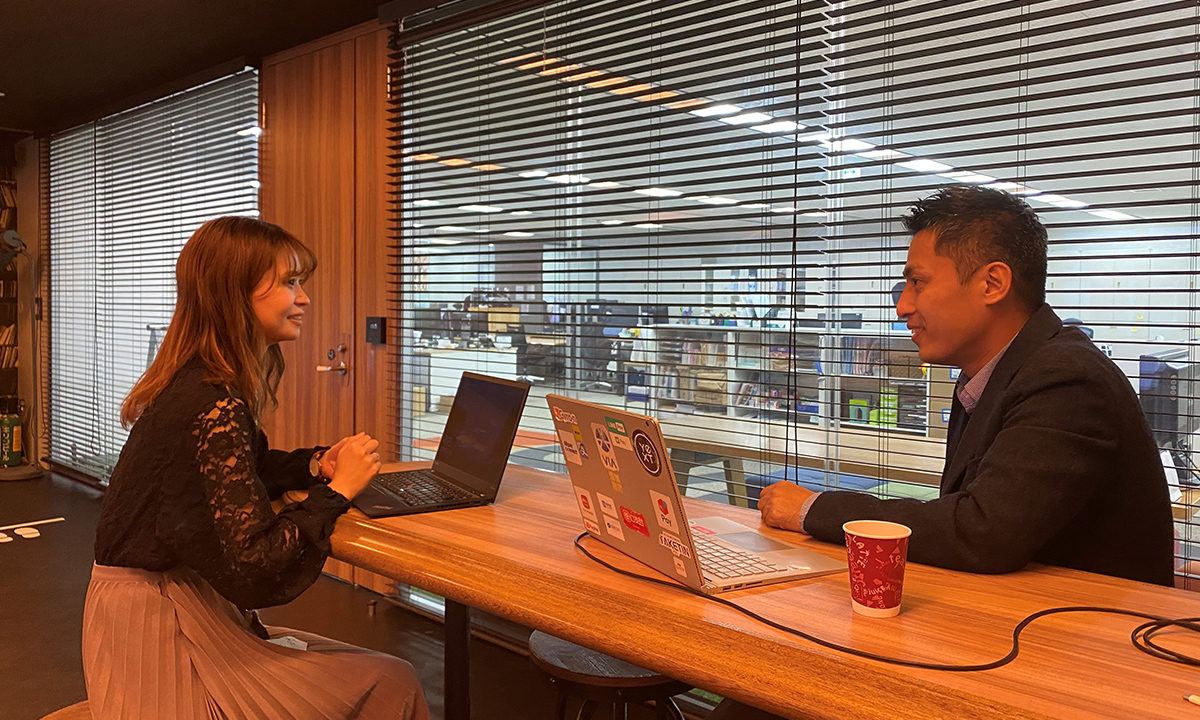
Yajima meeting with UPC President Nakao
Yajima produced a totally new company pamphlet and presentation materials, then went on to renew the company’s recruiting website, redesigning all those materials from the perspective of job-hunting students and working hard to get the information out.
“I borrowed the abilities of our Marketing Devision to develop the pamphlets and presentation slides used by HR. Because of the high quality design and copy of our new materials, they aroused student interest and engagement. We also put a lot of effort into regular updates on LINE, Instagram, and other social media. In the renewal of the UPC recruiting message, I wanted to communicate the company’s actual atmosphere.”
On the renewed hiring page, existing employees describe their reasons for choosing UPC and the content of their work. All content is tailored to provide the answers students are looking for. Besides spelling out in detail employee welfare benefits, this site also provides objective data on overtime and vacation days.
“UPC’s strengths are the humanity of its employees and an outstanding work environment. It’s an environment that welcomes failure, in which it is possible to succeed with help from NAKAMA who help you overcome challenges. Communicating this message is my responsibility,” says Yajima.
Yajima planned all sort of events, employee roundtables, and lunch meetings to get all sorts of other employees involved. She says that when current employees see hiring new graduates as “my business,” they quickly agree to cooperate. Students are able to get to know the company from a variety of angles. This not only strengthens their motivation to join the company; it minimizes the gap between them and other employees.
A Company with Three Times the Time for OJT

The biggest change in recruiting new graduates is in on-the-job training (OJT). Until 2020, only two months were spent on OJT, with new hires spending a week in each of the company’s divisions. Since 2021, the time spent on OJT has tripled from two to six months.
“With two months spread evenly over all the divisions, only a short time was spent in each division. Newcomers would only get to know a handful of other young employees. It wasn’t an environment in which it was possible for newcomers to understand the company, what each division did, and how its work related to that of the other divisions.”
Increasing OJT from two months to six made it possible for new recruits to spend a month in each division. Because of this change, everyone, not just a handful of current employees, became responsible for training the newcomers.
“Participation in OJT also changed existing employees. We saw unexpected growth in employees who had bitten the bullet to overcome challenges when they were asked to teach their juniors what they had learned.”
When everyone sees the big project to recruit new graduates as “my business,” that attitude contributes to their own growth. Because through OJT deeper ties are formed with new employees, more divisions are saying “We want new employees!” In 2021, for the first time, the new graduates included engineers.
With the coronavirus pandemic driving change at a dizzying rate, paying closer attention to students’ needs and anxieties is a way to create a feeling of solidarity when working online. That is another reason for getting everyone involved in welcoming new recruits. Yajima says this about her next objective:
“I want to strengthen follow-up during OJT. We also plan to recruit new graduates in Osaka. I want to strengthen the appeal of the company to talented people in the Kansai region.”
Finally, we asked for Karen Yajima’s feelings about UNIVA AWARDS 2021.
“I was really happy. This was my first entry for the UNIVA AWARDS. The Shining Star presentations were all amazing. I am truly grateful that I was chosen from this group of outstanding people. I will go on developing recruitment tools that pay closer attention to all sorts of students’ needs, working to contribute to UPC by recruiting exceptional talent.”
Karen Yajima, congratulations!