MESSAGE
Future Project 2024
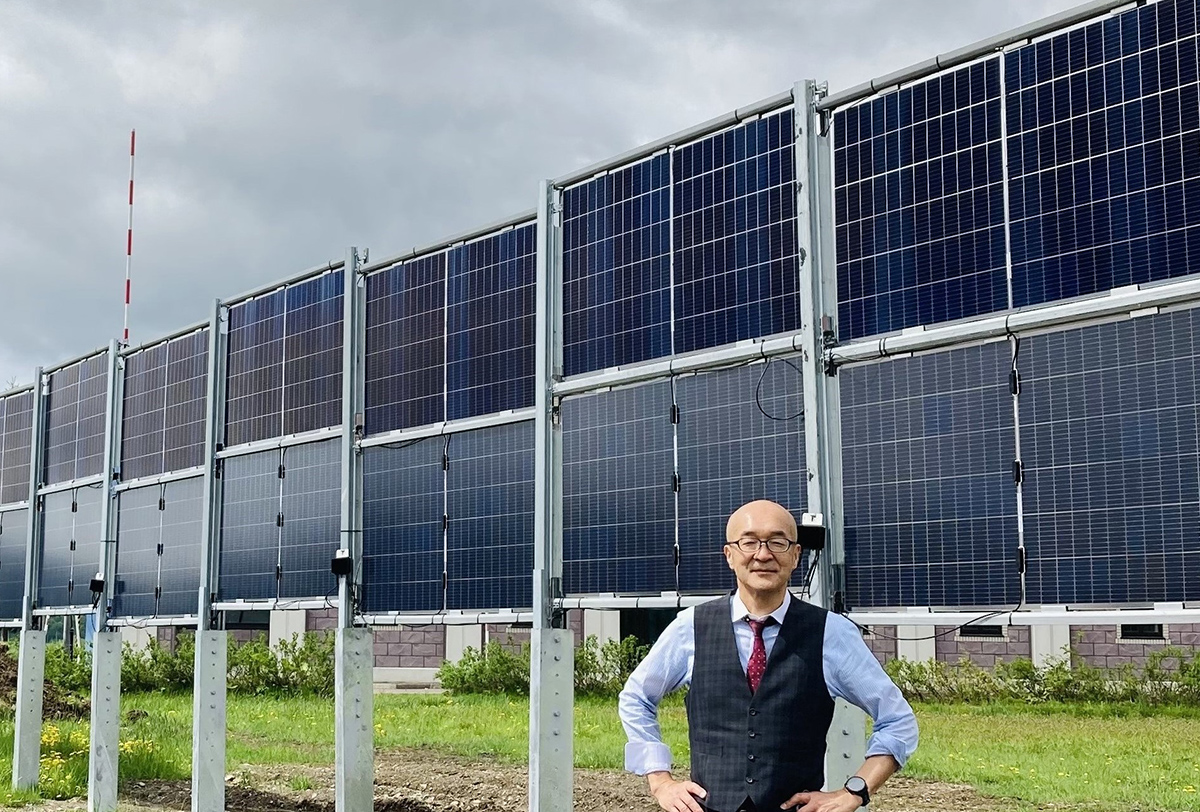
Recently, I have been spending time moving around Hokkaido than working in Tokyo.
Now, after the UJP Future Project.
In 2023, we opened two shared offices in Horokanai, the town with the smallest population(1,300 peopple) in Hokkaido. (We have won it through fair bidding!)
↓
https://www.horokanai-satellite.com/
And in 2024, the first demonstration test of vertical bifacial solar power in the municipality will be conducted in Horokanai Town.
Suichoku-Solar (German Japan subsidiary), UNIVA Japan, and North Energy have started the program.
Vertical double-sided sunlight??
Until a year ago, I wondered if there was such a thing in the world. I didn't even know that.
It was around this time last year. It was around the time that I became a board member of North Energy.
When I was talking to the mayor of Horokanai
"Mayor, there is no solar power in this town, why don't you install solar power?"
The mayor said with Hokkaido dialect,
"Mr. President, the snow cover in Horokanai is 3 meters, and if it snows like that, it will be destroyed."
Oh, I see!!! But then I had an epiphany!
(If you stand it vertically, it won't break! Let's look for vertical solar! The voice came from my heart)
After that, I hurriedly asked the director of North Energy to investigate the vertical solar, and finally found it!
We found out that a German company in Japan already has several units in heavy snowfall areas, so we contacted them immediately.
Then, three months after the first contact, we obtained the approval of the mayor of Horokanai Town and the town council.
This is the first time a municipality has installed vertical double-sided solar power in a heavy snowfall area.
By the way, does vertical solar really generate electricity efficiently???
In the midst of expectations and anxieties, the results of the demonstration test in January ~ April showed that it was!!
It has been demonstrated that it generates nearly 20% more electricity than ordinary diagonal solar power!
(It was also published in the Hokkaido Shimbun on March 30 as attached.)
The secret is the reflection (albedo) of the snow.
Normal oblique sunlight generates very little electricity in winter due to the snow cover. However, vertical sunlight in the first place, snow does not accumulate. And above all, the reflection of the snow makes it as good as sunlight from the ground.
Reflected light can be acquired. The amount of power generated by the reflected light depends on the crystal type of the solar module.
In some papers, monocrystalline modules can generate more power than direct light due to the characteristics of the reflection spectrum.
(Hachinohe Institute of Technology test results)
By the way, when there is no snow??? What about reflected light?
Don't worry!
After Golden Week, long holiday in late April and early May, the snow cover was finally gone in Horokanai. And yesterday, there was a Line message from the town hall.
"Mr. President, there is a pile of humus for soba noodles in the sun, so all you have to do is sow soba noodles!"
Horokanai Town is a famous soba production area that ranks first in Japan in terms of both acreage and yield.
And the soba flowers are in full bloom in July and August, and the white flowers of soba bloom all over Horokanai Town.
"Horokanai Town turns pure white twice a year, with snow in winter and soba blossoms in summer."
Next week we will sow buckwheat seeds in vertical sunlight.
Oh, by the time this manuscript is published, vertical sunlight is already generating electricity energetically surrounded by pure white buckwheat flowers!
UNIVA Japan Limited
President & CEO
Yoshiaki Ubatani