UNI-SQUARE
Serious Hobbies!
UNIVA Band Members’ Music

Our March UNI-SQUARE introduced NAKAMA passionately devoted to triathlon and marathon. We received many comments like the following:
“Running races in Europe every year?”
“Thirteen races a year!!! Amazing!”
It seems like all our NAKAMA were inspired by Tanaka and Hosaka.
This time we introduce two more must-know NAKAMA, musicians who are members of bands. Dominik Szczepanski and Yusuke Fukushima are both engineers who work for UNIVA Paycast (UPC). Coincidentally, they both received their first guitars as presents from their parents. We asked them about their interest in music and their everyday lives.
NAKAMA who live near Tokyo should please see them perform live.
From Punk to Visual: Dominik’s Bands
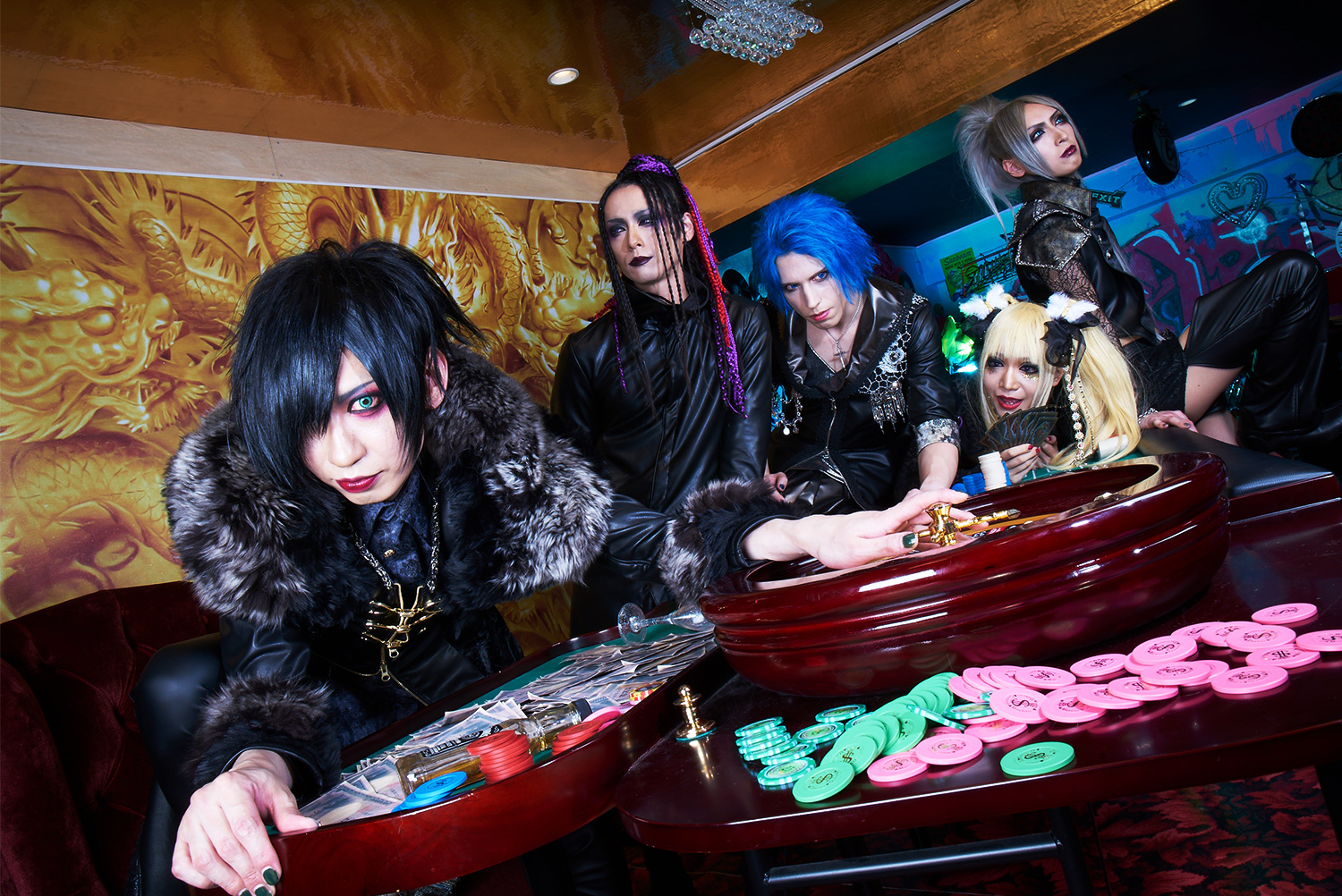
Band「GREED」
Dominik Szczepanski is from Poland and, besides music, was interested in the Japanese language. Starting in high school, he worked hard on his Japanese, and immediately after receiving his master’s degree passed level 1 of the Japanese certification examination. This, combined with his experience as an engineer, made it possible to find a job when he came to Japan in February 2017. After twice changing jobs, he joined UPC, where he works as a backend engineer, in April 2019. But how did he get started with music?
“I received my first acoustic guitar as a Christmas present from my parents when I was 13. However, I was in love with Metallica and wanted an electric guitar to play covers of their music. I was lucky. When I was 14, I got an electric guitar from a friend of my parents. Then I played nothing but songs by Metallica. I wasn’t very good (laughs).”
Then, at 16 he formed a punk band. At 19 he joined the Polish rock band NOFF, with which he played bass in four live performances a month, as well as radio broadcasts! He recalls how difficult it was to keep up with both his studies and the band. Unfortunately, when Dominik decided to move to Japan, the band dissolved. Then what?
“After coming to Japan, I helped out with a band formed by people I had known in Poland. These included talented songwriters and producers, so I was happy to do that. Then one of them went back to Poland, and the group split up after only half a year.”
Then, when Dominik was not active in other bands, he was approached by GREED, a “visual” band with elaborate costumes, hairstyles, and makeup. Dominik has allowed us to share a photograph from that period. Hard to imagine, isn’t it, how totally he was into this.

Visual bands mostly performed live on weekdays; but UPC’s make-your-own schedule work style allowed Dominik to play with this band. He was able to work 10 hours per day, four days a week, and still fit in four live events on weekdays. But playing with this kind of band required money.
“Yes, it certainly did. Since this was a visual band, the costumes, makeup and hairdressers were all expensive. It wasn’t possible without selling photos to diehard fans. And when there were fans, they quarreled with each other. The uncaring agency kept making threats. As a result, I quit GREED after a year and a half.”
One of the reasons the band broke up was the impossibility of life performance during the COVID pandemic. For a hobby, however, the conflicts and expense were too much.
THE NATIVE BROADCAST
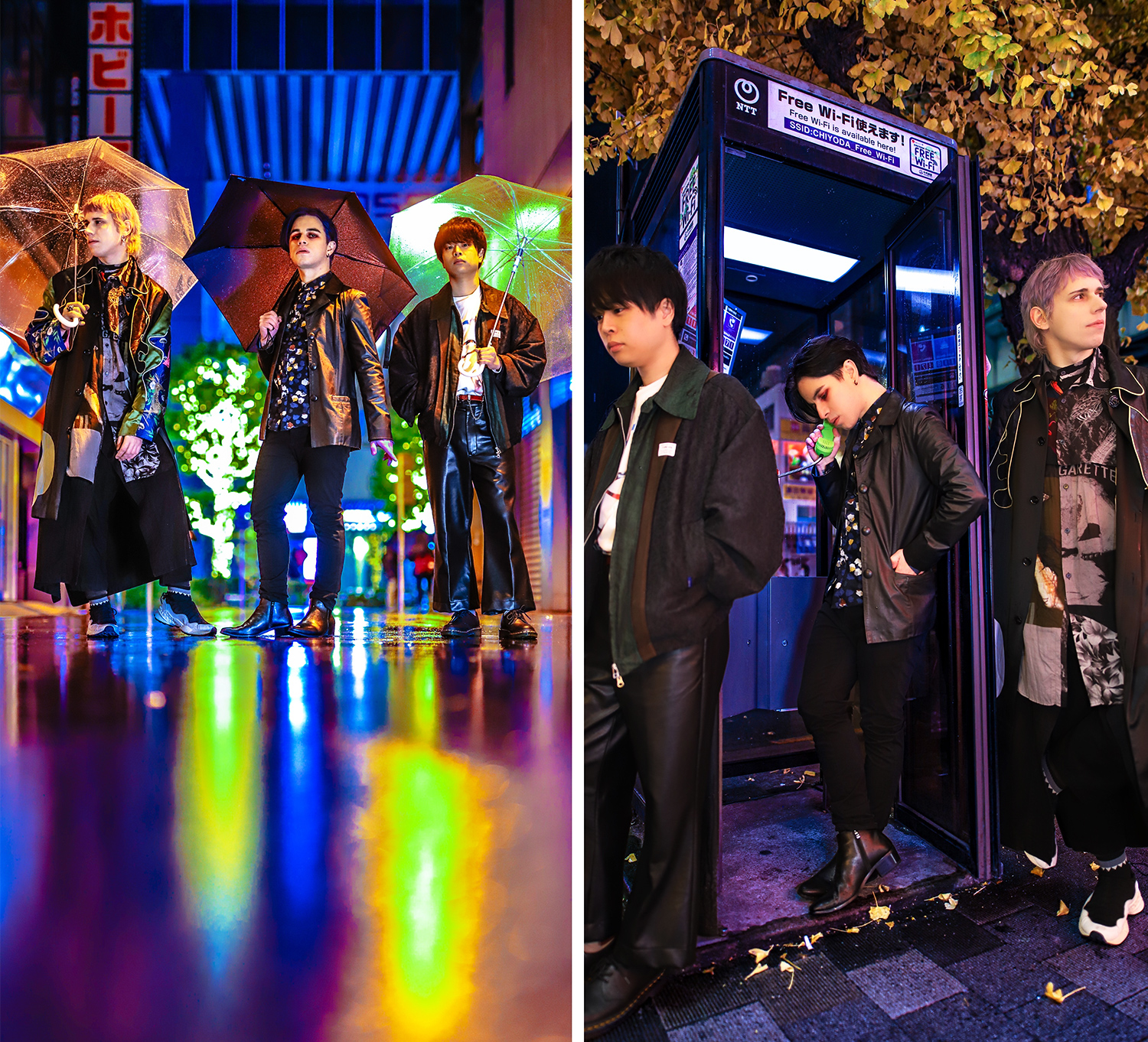
THE NATIVE BROADCAST
“A few days after my last live performance with GREED, a member of my first band contacted me. He wanted me to hear a new song he had written. As I listened to it, I got more and more excited. But we didn’t have members for a new band. Joy, the Brazilian raised in America who contacted me was a vocalist and guitarist. I was also a guitarist. So, we began by looking for a bass player and a drummer.”
They soon found a drummer, but a base player was hard to find. In the end that decided to forma trio. Joy, the Brazilian, was the vocalist. Yuki, the drummer, was Japanese. Dominik, who played the guitar, was from Poland. That is how the trio called THE NATIVE BROADCAST was born.
“The trio’s name embodies a variety of nuances: a group made up of international members, a variety of lifestyles and ways of doing things, consciousness of nationality and race, our wanting to bring music to all sorts of people without being confined to a single genre. We are now searching for our own sound.”
I have watched the music video for your new song Warblers. What is this song’s message?
“Warblers are the birds called ‘uguisu” in Japan. They are small and hard to notice, but they have beautiful voices. They are beautiful and familiar but often go unnoticed. The movie video’s protagonist is a girl who sees the personas that others present on social media but lacks self-confidence. She doesn’t know what to do to achieve social acceptance. She doesn’t understand what is good about herself. Our song conveys the message, ‘You may not see us, but you can hear our beautiful music’.”
We asked Dominik about his goals, for the trio and in his work.
“Music is my hobby, but I am serious about it. This year’s plans include two live performances per month and making two music videos. I want as many people as possible to hear us perform live. It would be great if we could perform at a big live house. At work I have become an assistant leader and I want to work hard to follow up with everyone on the team. Finishing a big project will depend on everyone succeeding.”
Dominik, thank you. I enjoyed your music video. Everyone be sure to follow THE NATIVE BROADCAST official site on Twitter.
A Working Adult Band Circle?

Next up is Yusuke Fukushima. At university he studied information engineering. After graduating in 2021, he joined UPC, where he is now a frontend developer in the Systems Division. He became interested in music in middle school, received a guitar as a birthday present from his parents and self-studied, practicing guitar night after night.
“When I entered high school, I joined the band as a club activity. Since I couldn’t do what I wanted to, I quit after one year. Then, at university I joined the working adult band circle in which I am still active.”
The working adult band circle’s organizers rent a live house once a month. Members who want to perform recruit band members. Five or six bands perform for thirty minutes each during each live event. What is surprising is the differing frequency with which individual band members participate in these events.
“The circle’s members approach each other and ask ‘Would you like to perform at the next live event?’ It is also possible for the organizers to help recruit members for a band. Once a band is formed, the members get together to discuss what songs they want to perform. They will rehearse the songs they choose twice before the live event.”
Fukushima performs at live events once every three months. He sang at his first live event this year on February 4. Besides Fukushima, the band’s six members included musicians playing the electric guitar, acoustic guitar, bass, drums, and keyboard. They performed five pieces by Kenshi Yonezu. A solo vocal featured the acoustic guitarist accompanying himself.
Personal Enjoyment No. 1

Fukushima’s band has until now been a “copy band” performing J-POP by Kazuyoshi Saito and anime songs. Fukushima’s favorite band is Porno Graffitti.
“Porno Graffitti was the reason I started guitar. I just like them and own all of the more than 200 songs that they have released. Not even one sounds like the others, and none are songs of which you get tired if you play them over and over again. They have been a top-ranked band for a long time but never stop looking for something new in their music. They are terrific!”
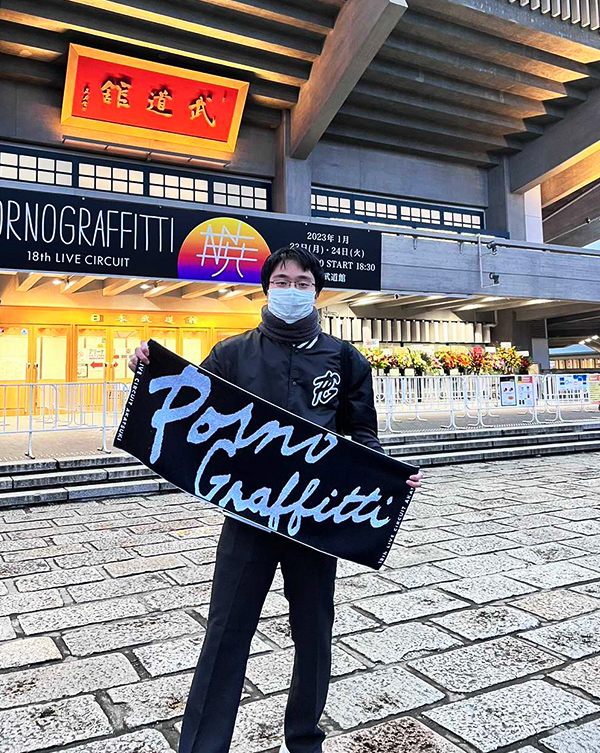
Going to Porno Graffitti’s live
Fukushima’s only voice practice has been karaoke. Whether or not he is performing live, he spends at least two hours once a week singing karaoke. Recently he has started voice training to be able to sing higher-pitched songs. What, then, is being in a band to Fukushima?
“Music is a hobby. That I enjoy making music is reason No.1. It isn’t that I have no interest in auditioning; but I like keeping work and hobby separated.”
Fukushima makes a point of never repeating a song when he performs at the live events. For each event he chooses a different song and an arrangement for the band that fits the mood of that number. Since every time he performs the band’s members are different, he enjoys this very much. But doesn’t belonging to the working adult band circle cost money?
“To perform at a live event costs around ¥6000. There are times when the audience is large and we make money, but that is very rare. Studios for rehearsals and costumes also require money.”
UPC NAKAMA sometimes go to live houses. While Dominik and Fukushima perform different genres, both are having fun. We ask Fukushima about his goals at work.
“Now I work mainly on frontend development, but this year I am supposed to be given the opportunity to experience backend development. I want to absorb all sorts of things, improve my skills, and get a higher salary. That way, I will be able to freely enjoy the things that I like.”
Dominik-san, Fukushima-san, thank you so much.